Most BAS teams invest heavily in technical training. Very few invest in training their techs how to communicate with building owners, facility managers, contractors, and internal teams under real job pressure.
That gap shows up in expensive ways:
The work gets done, but the customer feels dismissed, rushed, or ignored.
Techs say yes when they should set boundaries, or say no in a way that creates friction.
Under pressure, even solid techs can become abrupt, passive, defensive, or unclear.
Escalations, strained customer relationships, and unnecessary account risk all stem from communication failures that could have been prevented.
Until now, industry-specific communication training for BAS technicians has been nearly nonexistent.
Most communication courses are too generic. They are not built around jobsite conversations, customer tension, scope creep, frustrated building staff, or the pressure techs feel when they are expected to have answers immediately.
This completely online program was designed around the real communication moments that shape customer trust in building automation:
This is not theory-heavy training. It is applied practice for real field situations. The live sessions center on discussion, case studies, paired review, and role-play scenarios tied directly to BAS work.
By the end of the program, participants will be better equipped to handle the conversations that shape customer confidence and account retention.
-1.png?width=150&height=150&name=Untitled%20design%20(4)-1.png)
-1.png?width=150&height=150&name=Untitled%20design%20(6)-1.png)
-1.png?width=150&height=150&name=Untitled%20design%20(7)-1.png)
-1.png?width=150&height=150&name=Untitled%20design%20(8)-1.png)
-2.png?width=150&height=150&name=Untitled%20design%20(9)-2.png)
-1.png?width=150&height=150&name=Untitled%20design%20(10)-1.png)
The course blends self-paced learning, on-the-job application, and live practice so students do more than just learn concepts.
-1.png?width=150&height=150&name=Untitled%20design%20(11)-1.png)
.png?width=150&height=150&name=Untitled%20design%20(12).png)
-1.png?width=150&height=150&name=Untitled%20design%20(13)-1.png)
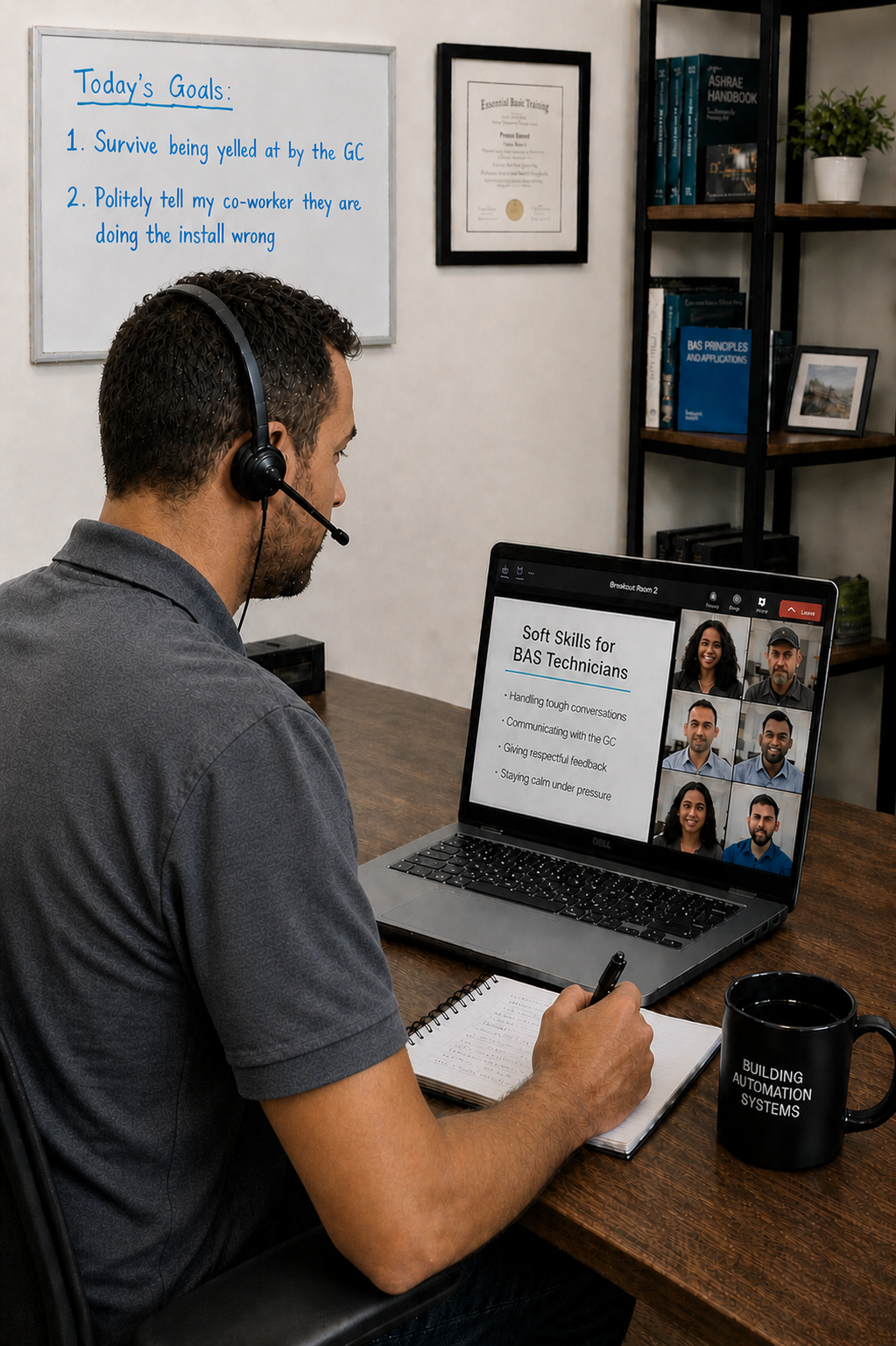
Students learn to identify communication styles, adjust their delivery, and avoid the common mistakes that create mistrust early in a service interaction.
Students learn concepts such as:
In this module, students learn to stop guessing and start diagnosing with clarity. They will learn how to ask better questions, uncover the full picture faster, and make customers feel heard and understood.
Students learn concepts such as:
In this module, the student learns to slow down and think before they act. This module teaches them how to identify root causes (not just symptoms) and make smarter decisions when the pressure is on.
Students learn concepts such as:
In this one, students learn to develop the mindset and habits that move their career forward. They will learn how to handle feedback, bounce back from setbacks, and work effectively across different personalities and generations.
Students learn concepts such as:
Students learn to master the day-to-day behaviors that define top performers - such as, writing clear reports, setting boundaries professionally, and communicating safety concerns with confidence without creating conflict.
Students learn concepts such as:
❌ Broad business examples
❌ Mostly theory
❌ One-and-done workshop
❌ Minimal manager involvement
❌ Limited application
✅ Built around BAS field situations
✅ 100% online
✅ Real customer and technician scenarios
✅ 10-week reinforcement cycle
✅ Bi-weekly manager support emails
✅ Field logs tied to live work

Each live session is built around active participation, not passive listening.
In the live sessions, students:
This is where techs build confidence through guided practice, not just information.
This program does not leave behavior change to chance.
At the start of the program, students complete an assessment of their customer communication skills. At the end, they complete an Action and Commitment Plan that identifies strengths, weaknesses, and how they plan to improve. That plan is shared with their manager to support continued growth.
Managers also receive a bi-weekly Module Report explaining what the student is learning in each module and how to reinforce it on the job.
This course is ideal for:
This course is especially valuable if your team needs help with:

Enrollment Closes
July 22nd, 2026
Orientation
July 29th, 2026
Cohort Starts
August 3rd, 2026
Cohort Ends
October 9th, 2026
Enrollment Closes
August 12th, 2026
Orientation
August 19th, 2026
Cohort Starts
August 24th, 2026
Cohort Ends
October 30th, 2026
Both. Students complete interactive self-paced work in each module, then join live virtual sessions every other Thursday for discussion, case work, and role play practice.
The program runs for 10 weeks and includes 5 modules and 5 live sessions.
Each module is broken down into 2 weeks (Week A and Week B). Students complete their online self-paced work from Monday through Wednesday during Week A of each module cycle. This typically takes about 1 to 2 hours.
Then, starting no later than Thursday of Week A, the student completes their Field Log assignment that is due on Wednesday of Week B. The Field Log requires minimum of 2 entries. These entries are based on real-life experiences they have during the work days of Week A & B with co-workers, customers, etc. Each entry has prompts for the student to answer. The prompts are specific to the skills being taught in the module. The Field Log can take 30 minutes to 1 hour to complete filling in the answers.
Students review their Field Log experiences in pairs, discuss case studies as a group, and practice role plays tied directly to the module skills in pairs.
No. This program is designed specifically for BAS technicians and the communication situations they face in the field. This program was created by an SBA instructor who is a licensed clinical mental health professional with the assistance of SBA's instructors who are experts in BAS.
Yes. Managers receive bi-weekly module updates on what students are learning, and each student completes an end-of-program action and commitment plan that is shared with their manager.
The course is built around repeated application: self-paced learning, field log reflection, live discussion, role play practice, and manager reinforcement.
Questions about Smart Buildings Academy?
Please reach out today.
800-484-0113